
The history of Magnetic Island spans thousands of years, shaped by its Traditional Owners, European settlers, wartime significance and its evolution into a beloved holiday destination. Today, visitors can explore walking tracks, heritage sites and cultural landmarks that reflect the rich layers of Magnetic Island history, from Dreamtime stories to World War II defence structures.
INDIGENOUS HISTORY

Yunbenun, the island’s original name, holds deep cultural and spiritual meaning in the history of Magnetic Island. The Wulgurukaba people lived seasonally across several bays, travelling to the mainland by canoe. Shell middens, stone tools and art sites remain as physical markers of their long connection to this landscape. Dreamtime stories, including the Big Carpet Snake narrative linking Magnetic and Palm Islands, explain the creation of the landforms that define the island today.
Traditional life continued until the 1890s, when the development of Townsville’s port disrupted food sources and cultural practices. While many Wulgurukaba people were eventually displaced, a small number remain connected to the island today, continuing an important chapter in Magnetic Island history.
EUROPEAN SETTLEMENT

The European chapter of the history of Magnetic Island began in 1770, when Captain James Cook believed the island’s granite boulders were affecting the compass on the Endeavour. Although the theory was never proven, his naming of “Magnetical Isle” endured.
By the late 19th century, the island had become a popular leisure destination, with Picnic Bay emerging as the first tourism hub. Coral, timber and stone were harvested for construction in Townsville, and small amounts of gold were mined. In 1885, a quarantine station was built at West Point, adding another layer to the island’s evolving story.
WORLD WAR II

A major turning point in the history of Magnetic Island came during World War II. Townsville became a strategic military base, and Magnetic Island played a critical defensive role. Between 1942 and 1943, a Signal Station, Coastal Battery and radar facilities were constructed across the island.
The Forts complex — now one of the most visited historical walks in the region — operated until 1945 and remains a protected heritage site. Visitors today can experience this chapter of Magnetic Island history first-hand while enjoying panoramic coastal views.
EARLY TOURISM
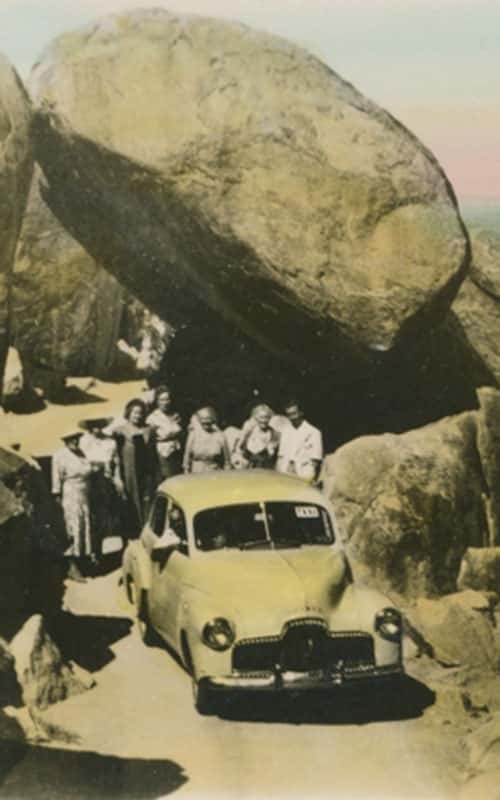
Tourism blossomed in the early 20th century, with Picnic Bay, Nelly Bay and Arcadia each forming small but vibrant communities. Picnic Bay was named after its popularity as a picnic spot for European tourists from the mainland during the 19th century, before Magnetic Island was first inhabited by Europeans. In the mid-19th century the island became a popular location for the collection of stone and coral needed for development on the mainland. Pine trees on Magnetic Island were harvested in the 1870s, but the first permanent European resident is thought to have been Harry Butler probably in the late 1870s. His daughter Ellen, born 1872, was known as Nellie, and it was after her that Nelly Bay was named. She remained on the island to manage a guest house. Not far from the Butler guest house, Robert Hayles erected a hotel at Picnic Bay in 1899. He added a jetty and a dance hall and his business developed as Hayles launch and cruising service.
By the 1920s Magnetic Island was both popular and populated. Residents carried out mixed farming, fruit growing (especially pineapples) and dairying. A Townsville tourist guide (1924) described the island as ideal for surf bathing and a picnic resort, ‘nestling in the bosom of Cleveland Bay … where brain fog is quickly dispelled and highly-strung nerves are soothed’.Both Picnic Bay and Nelly Bay had dance pavilions, the latter including the thatched Mandalay guest house (1912) and Dutch-design cottages. Alma Bay at Arcadia was a favoured swimming spot. All three places had jetties. A school was at Picnic Bay and another was opened in an old kiosk at Mandalay, Nelly Bay in 1924. A tiny building, it later served as an Anglican church. Picnic Bay’s school (1921) closed in 1970 and later became a craft shop. It is heritage-listed. The Picnic Bay surf life-saving club began in 1927.Horseshoe Bay, the island’s longest beach on the northern shore, was first settled by Europeans in 1912, but only for a few years. The next settlement was a nearby defence fort built in 1942 to protect Townsville. It is on the Australian heritage register.


